


Professor of Computer Vision and Artificial Intelligence, University of Surrey
Senior Principal Scientist, Adobe Research
Professor John Collomosse is the founder and director of DECaDE, the UKRI Research Centre for the Decentralized Digital Economy led by CVSSP at the University of Surrey [1]. His research intersects Artificial Intelligence (AI) and Distributed Ledger Technology (DLT), with focus on media provenance to fight misinformation and online harms, and on improving data integrity and attribution for responsible AI. John leads the research programme for Adobe's Content Authenticity Initiative (CAI) having co-founded the CAI upon joining Adobe Research in 2019. He leads two cross-industry task forces within the C2PA open standards body for media authenticity spearheaded by the CAI. Prior to his focus on media provenance and online harms, his research has also explored creative forms of visual search and content recommendation, and immersive technologies. He is a chartered engineer and member of the UKRI Science Engineering and Technology Board (SETB) and the UKRI Advisory Group for Digital Research Infrastructure (AGD). His UK Government advisory roles include membership of the BIST/DSIT College of Experts, and the DCMS Creative Industries Council (CIC). Between 2025-2026 he was a member of the DCMS working group on controls and technical standards for Copyright and AI. Between 2008-2014 he was a member of the EPSRC strategic advisory team for Information & Communication Technologies (ICT) and the UKRI Digital Economy programme.
Extended Biography

John has published over 170 papers (h-index 46, 7600+ citations) and over 30 granted patents in Artificial Intelligence (AI), spanning a 20+ year career in AI that began with his first Faculty tenure-track appointment at the University of Bath aged 25. He is now concurrently both a Professor of AI at the University of Surrey, and a Senior Principal Scientist at Adobe Research, where he leads research for Adobe's Content Authenticity Initiative (CAI) via his Trusted Media Intelligence (TMI) lab within Adobe Research. He is a Chartered Engineer (CEng), and Fellow of the IET (FIET), Fellow of the British Computer Society (FBCS) and Fellow of the Royal Society of Arts (FRSA). He is a member of the UKRI Science and Engineering Technology Board (SETB) since 2026, a member of the UKRI Advisory Group for Digital Research Infrastructure (AGD), and between 2018-2024 was a strategic advisor (SAT member) to the UK Science Council (EPSRC) ICT programme and UKRI Digital Economy programme. John founded and directs DECaDE, the national UKRI Research Centre for the Decentralized Digital Economy researching data provenance and digital supply chain technologies for the future creative economy. He is a member of the UK government's BIST/DSIT College of Experts and the DCMS Creative Industries Council (CIC). During 2025-2026 he was a member of the DCMS working group on controls and technical standards for Copyright and AI.
John’s research focuses on media provenance – tracing the origin of images, video etc. – in order to fight misinformation and enhance responsible use of AI. Notably, he led the ARCHANGEL project (2017) which pioneered use of cryptographic metadata and fingerprinting on blockchain for media integrity in sovereign public archives, including the UK and USA (NARA) National Archives. The research was identified by the UK Science Council (EPSRC) as a highlight of its 10-year UKRI Digital Economy programme, and subsequently led to the formation of the Content Authenticity Initiative (CAI) around media provenance out of Adobe Research in 2019.
John leads AI research for Adobe’s Content Authenticity Initiative (CAI) and is a core technical advisor to the initiative since co-founding the initiatve upon joining Adobe in 2019. Now with 6000+ members, CAI leads a cross-industry standards group (C2PA; Coalition for Content Provenance and Authenticity) where John chairs two cross-industry task forces focused on Blockchain and watermarking for media provenance. Notably, John pioneered the use of watermarking and fingerprinting for robust media provenance, leading development of the C2PA cross-industry standard in this area. His durable content credentials research is used to underscore attribution and integrity for billions of assets across Adobe’s platforms such as Photoshop, Lightroom and generative AI Firefly tools. John has presented his provenance work in international keynotes including at CVPR, ECCV, and to UK/EU government and public bodies including the IET, government roundtables, given oral testimony to the House of Lords Communication and Digital Select Committee, and to the All-Party Parliamentary Group (APPG) on Blockchain.
John pioneered several AI visual search technologies, such as searching image collections based on their artistic style, using hand-drawn sketches, or using human pose to search choreography. These technologies were shipped in platforms such as Behance.net, and the AHRC Digital Dance Archives portal. John also developed the University of Surrey’s first taught modules in Computer Vision and AI/Deep Learning, and its first AI Masters (MSc.) programme combining AI, Robotics and Computer Vision. He was awarded the University’s Tony Jeans prize for inspirational teaching in 2016.
John’s early/PhD thesis research developed some of the earliest computer vision technologies to create the kind of artistic filtering effects now commonly found in tools like Instagram or Photoshop, and was featured in the BBC, New Scientist and front-page of the Times Higher (THES) also reaching the final of the UK Parliament ‘SET for Britain’ competition. John has also spent previous periods of time in industry R&D, including at Hewlett Packard Labs (Bristol) under a Royal Academy of Engineering (RAEng) fellowship, as well as Vodafone R&D (Munich) and IBM Research Europe (Hursley). At IBM he worked on machine language translation. If you used a cash machine (ATM) circa 2000, then you probably ran code that John’s code had written!
Profile Images
These images may be used freely under CC BY 4.0 (Creative Commons Attribution 4.0 International).







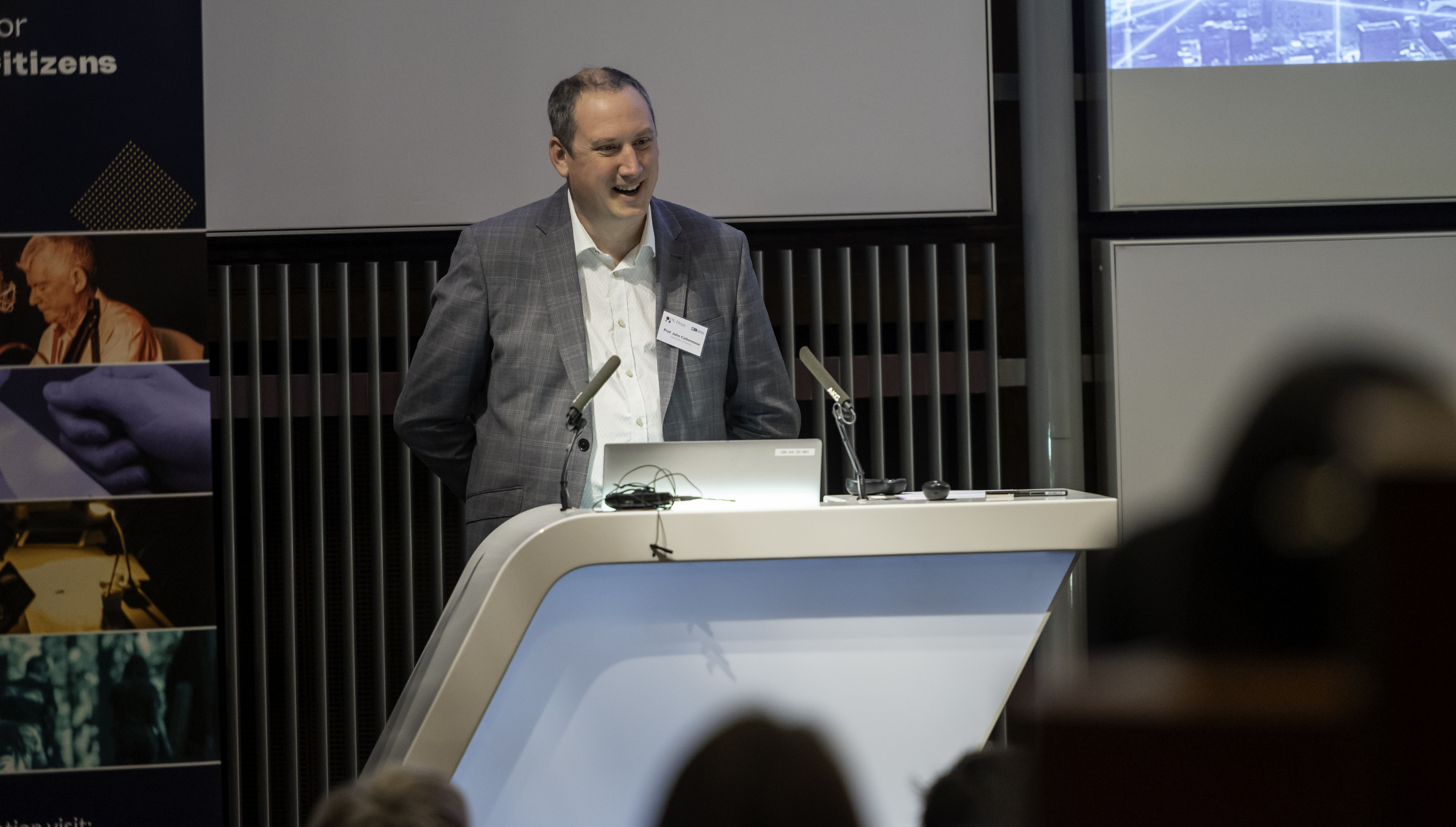




[1] Centre for Vision Speech and Signal Processing (CVSSP)
Founded in 1986 by Professor Josef Kittler and now directed by Professor Adrian Hilton, the Centre for Vision, Speech and Signal Processing (CVSSP) is part of the School of Computer Science and Electronic Engineering (CSEE) at the University of Surrey. CVSSP is internationally recognised for pioneering research in computer vision, machine learning, audio-visual AI, biometrics, and visual media. With more than 150 researchers, CVSSP is one of the largest audio and vision research groups in Europe. The Centre is currently ranked 1st in the UK, 3rd in Europe, and among the world’s leading computer vision research groups according to CSRankings 2025. Research at CVSSP has led to award-winning spin-out companies including AvatarMe, Mirriad, and OmniPerception, and has contributed foundational advances in computer vision, pattern recognition, machine learning, and multimedia understanding.